The first time I stood at the edge of a mangrove forest in Mombasa County, I didn’t see trees. I saw a living wall, roots arching out of the water like fingers holding the coastline together, sheltering fish, trapping sediment, absorbing carbon. The people living adjacent to this landscape had always known this. They could read the tide by the way the roots breathed. They knew which months the fish were most abundant beneath the canopy, and which species of bird announced the rains.
A Connection Deeper Than the Tide
Youth Pawa was born from that understanding: that young people, rooted in their own communities, are the most powerful force for restoring what has been lost. We believe that young people have the power to shape a more sustainable world.
Kenya’s coast has lost significant stretches of mangrove cover over the past three decades to socio-economic reasons like charcoal burning, clearing for aquaculture, and other development pressure. What remains is under constant threat. But it is not gone. And where it is gone, it can come back, if communities lead.
What Youth Pawa Has Built
Youth Pawa is a Kenyan youth-led organisation focusing on restoring nature’s ecosystems while empowering the local communities. Since we began, our team and the communities we work with have planted over 30,000 mangroves in 3 different degraded sites in both Mombasa and Kwale counties, seedling by seedling, season by season, in partnership with the people who know this landscape best.
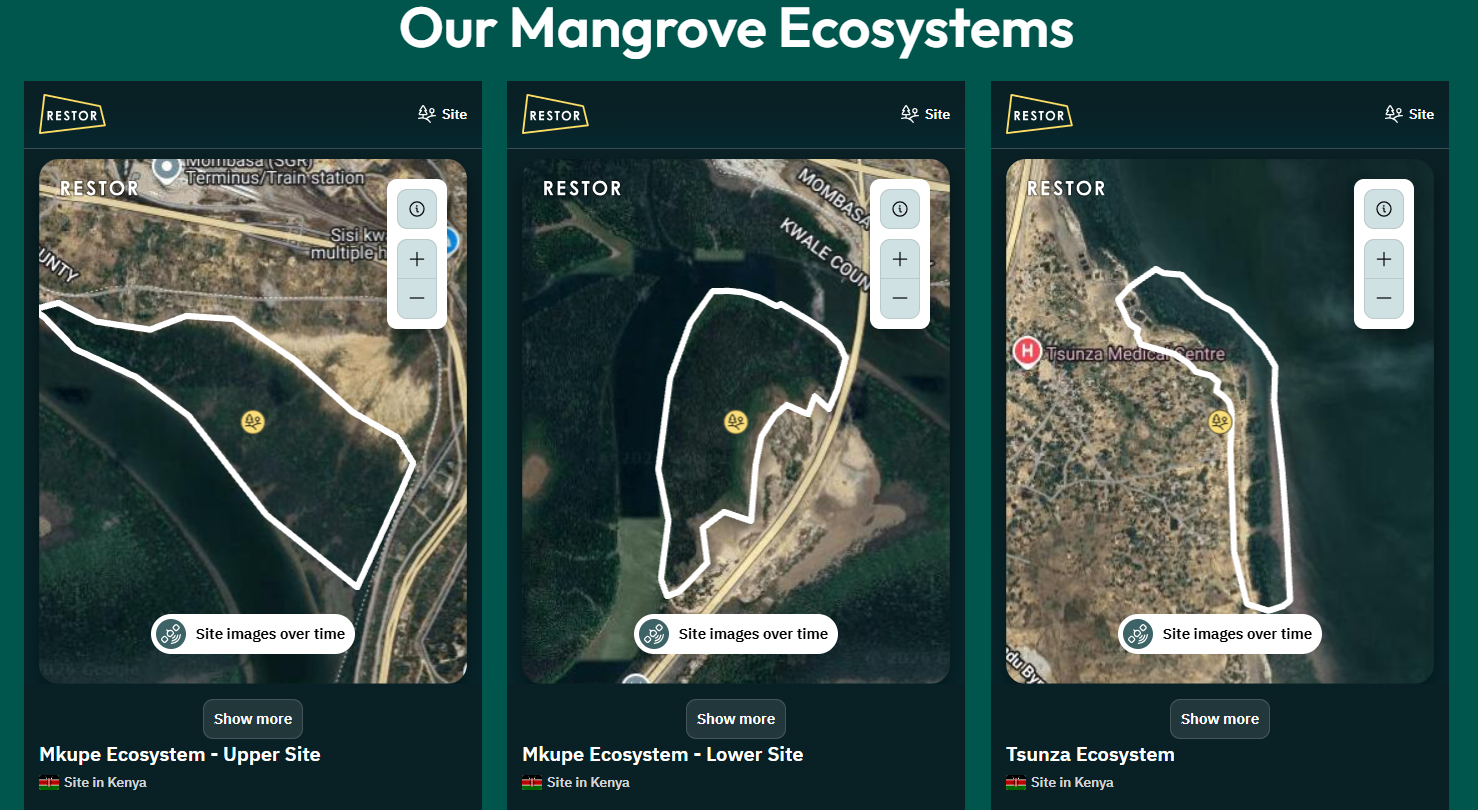
Our mangrove sites, in Mombasa & Kwale. Photo credits: Restor
Our model is deliberately community-centred, and we are guided by the Community-Based Ecological Mangrove Restoration (CBEMR) approach. CBEMR, unlike many planting projects, takes into account mangrove biology and ecology in addition to the socio-economic aspects that can affect restoration efforts. By doing so, it mimics natural processes such as regeneration to produce a more biodiverse mangrove forest cost-effectively and efficiently. We also don’t arrive with outside expertise and leave when the funding cycle ends. We work with local fishermen, women’s groups, and young people who have grown up beside these forests. They know the terrain, they know the tides, and they have a personal stake in whether the forest survives.
Beyond the trees, our work touches on:
- Youth engagement and environmental education – equipping young people along the coast and the wider area with the knowledge and agency to become environmental stewards in their own right.
- Sustainable alternative livelihoods – we introduced sustainable mangrove beekeeping to our restored site to support our local communities in their livelihoods. The bees produce honey that can be sold and also provide protection to the site from people who intend to destroy it.
- Climate resilience – for coastal communities already facing rising seas, intensifying storms, and shifting fish populations, a restored mangrove forest is not abstract climate action. It is protection. Mangroves stabilize the coastal area and help regulate the climate.
What We’ve Learned
Restoration is not planting. Anyone can plant a seedling. Restoration is everything that happens before and after the community conversations, the site selection, the monitoring, the protection from destruction, the long seasons of watching and waiting.
We’ve learned that the communities who depend on these forests are their best guardians, when they are treated as partners, not beneficiaries. We’ve learned that young people, given genuine responsibility and visible impact, will carry conservation forward in ways that no outside programme can sustain.
We’ve also learned that mangrove restoration sits at a uniquely powerful intersection: ecology, livelihoods, climate mitigation, and community identity. All in one place, all supporting each other.
Looking Ahead
As we approach World Mangrove Day on 26 July, Youth Pawa is moving into the next phase of our restoration work. Our goals are to expand our planting sites within the wider Kenyan coast, deepen community monitoring capacity, support more local households with a sustainable source of their livelihoods, and build an educational curriculum that will be used to educate and teach other people about the importance of mangroves and the ocean at large, in all areas, both the coast and the mainland.
We are also investing in media and storytelling because the world needs to see what community-led restoration looks like from the inside: the early mornings in the water, the survival rates being monitored, the young people who started as volunteers and are now leading site teams.
Every mangrove we plant is a statement: that young people are not waiting for the world to solve the climate crisis. We are building solutions, root by root, on our own coastlines in our own contexts.
By Enock Kitheka, Project Lead, Youth Pawa