Portugal has lost over half its forest cover in twenty-five years. Wildfire is the main driver, and each fire makes the next one more likely: burned slopes lose topsoil to the rain, springs dry up, native seedlings cannot establish, and invasive species take over. The landscape gets stuck in a loop that makes recovery harder with every passing season. The villages downstream carry it as worsening floods, landslides and water shortages. Many have lost close to half their population, and with them the younger generation’s connection to the forests that sustained them. Globally, around 500 trees are lost every second, and only about 50 are planted.
The bottleneck is terrain. Over half of Mediterranean forest sits on steep, mountainous slopes, which is exactly where wildfire hits hardest. Manual crews avoid steep ground because it is slow and because it is dangerous, with roughly one in five workers injured each season. Tractors cannot climb it. Drones scatter seed with near-zero survival, and on steep ground the rain washes that seed downhill anyway. The areas that need restoration most are the ones nobody can reach.
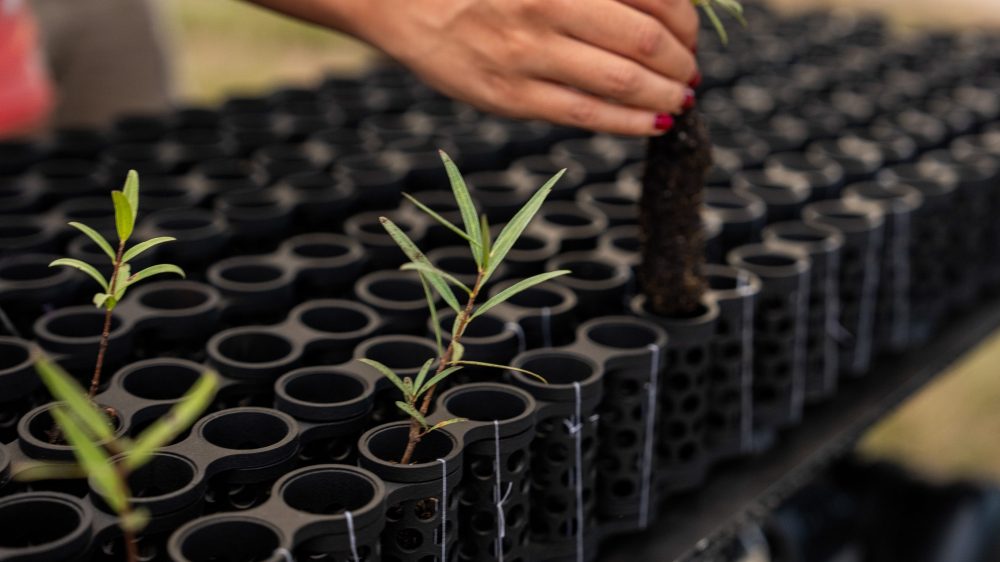
Trovador is a walking planting robot built for that ground. It reaches slopes that defeat crews and machinery, and it plants rooted seedlings rather than scattering seeds, which is the difference between a hillside that recovers and one that stays bare. It is in field testing now with Mafra National Park, ahead of a first big pilot this autumn.
The Winner.
Sebastião Mendonça and Marta Bernardino are 20. They built the first Trovador prototype out of recycled materials for €15, and it only lasted a single outing. Both took gap years to keep going and built two more prototypes. Each one showed them what to change next, and after three years, the project has been recognised by the UN Environment Programme, National Geographic and WWF. They work alongside restoration organisations including Life Terra, ForestWISE CoLAB and Mafra National Park as a technology partner rather than a replacement, and they are clear about what the robot is for. It only operates where people cannot safely work at all. It adds reach and does not take jobs.
Impact.
The $10,000 covers the step between the current prototype and a field-ready robot, then a monitored ten-hectare pilot at Mafra National Park on forest ground that burned over twenty years ago and still hasn’t come back. The first proof of concept reached 90% survival at twelve months with no post-care, and ForestWISE CoLAB will assess planting quality and survival independently at their next pilots. That independent evidence is what turns a student project into a tool professional restoration organisations will trust, and what unlocks the 500,000 trees already sitting in signed letters of intent from 2027. Local young people run the full cycle alongside it, building robots in workshops, growing seedlings, and monitoring survival as citizen scientists.
Support this project.
Thanks for downloading the Youth Funding Toolkit
Sign up below to stay updated and receive updates from us.